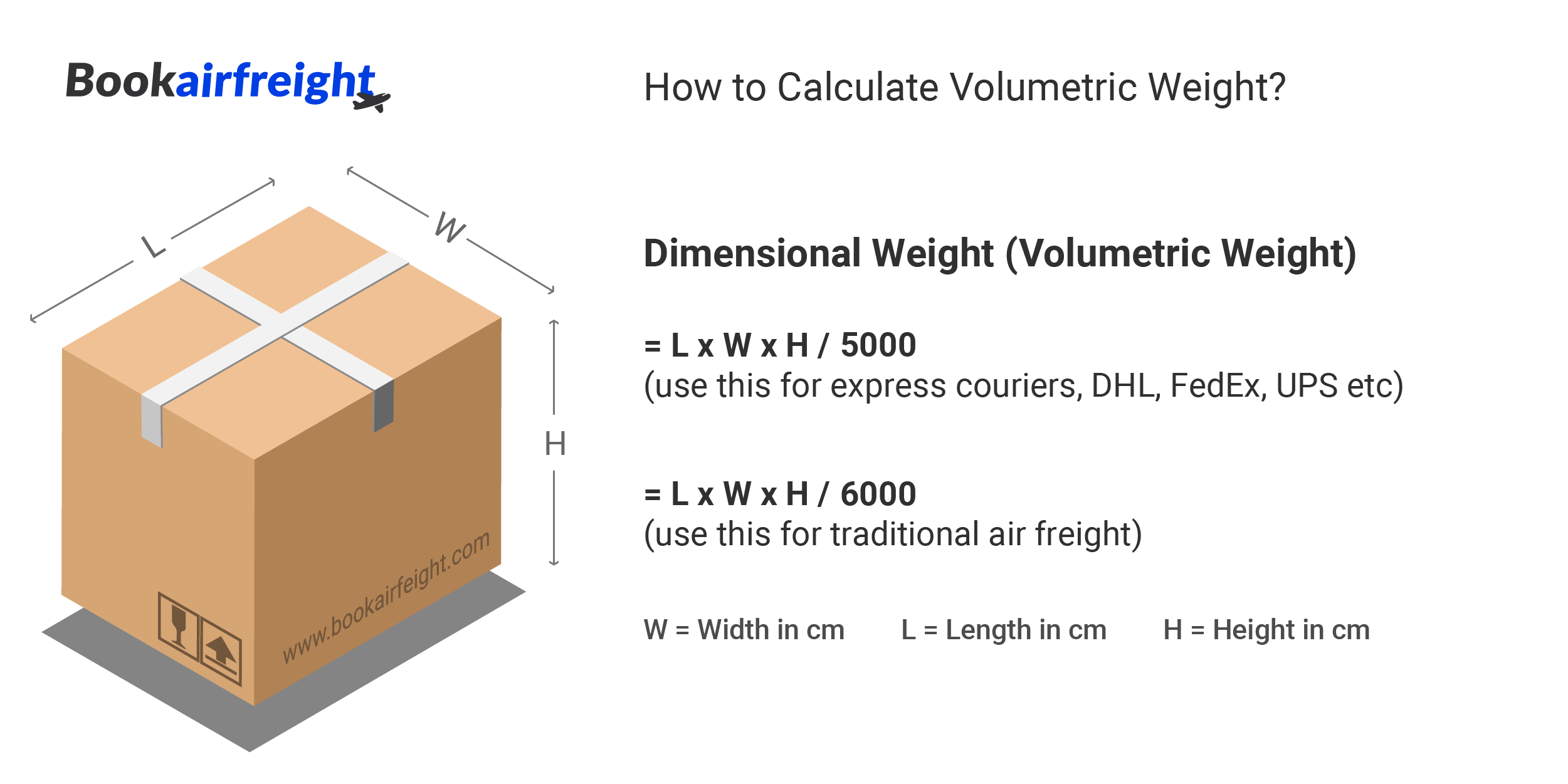
To calculate volumetric weight, you measure your parcel's dimensions in centimeters, multiply them together (Length x Width x Height), and then divide that number by a specific volumetric divisor, typically 5000. This result, known as dimensional or volumetric weight, reflects the amount of space an item occupies. Shipping carriers will compare this to the actual weight and charge based on whichever value is higher to account for bulky, lightweight items that take up significant cargo space.

What Exactly is Volumetric Weight?
Volumetric weight, also known as dimensional weight, is a pricing technique used by shipping and logistics companies to determine the cost of shipping. It’s a measurement of a parcel's density, essentially converting the amount of space it takes up into a weight equivalent. Think of it this way: a one-kilogram box of feathers takes up vastly more space than a one-kilogram dumbbell. If shipping were based on actual weight alone, the feathers would be incredibly cheap to ship despite filling a large portion of a delivery truck or airplane cargo hold.
To ensure fair pricing that accounts for both weight and space, carriers created the concept of volumetric weight. By calculating a parcel's volume and applying a specific divisor, they can assign a "weight" based on its size. This prevents shippers from being penalized for heavy, compact items and ensures that those sending large, lightweight goods pay their fair share for the space they occupy. For anyone shipping items internationally, especially "hauls" with varied products, this is a fundamental concept for managing costs.
Why is Understanding Volumetric Weight Crucial for International Hauls?
When you're assembling a haul of items from various online platforms to ship internationally, managing shipping costs is paramount. The single biggest factor that catches people by surprise is volumetric weight. An airplane's cargo hold has a finite amount of space, and this space is often more of a limiting factor than the total weight it can carry. Carriers need to maximize the revenue from every cubic meter of that space.
Ignoring volumetric weight can lead to drastically underestimated shipping fees. You might have a collection of items that only weighs 5 kg, but if they are bulky—like sneakers in boxes, puffy jackets, or hats—their combined volumetric weight could be 10 kg or more. The shipping company will charge you for the 10 kg value. Understanding this allows you to make smarter purchasing and packing decisions *before* you commit to shipping, helping you to budget accurately and avoid unexpected expenses when it's time to ship your parcel from the warehouse.
How Do You Calculate Volumetric Weight?
Calculating volumetric weight involves a simple formula, but its application requires careful measurement and knowledge of the correct divisor for your chosen shipping line. The process is straightforward and essential for estimating your shipping costs accurately.
The Standard Formula Explained
The universal formula for calculating volumetric weight is consistent across the industry. You need to measure the three dimensions of your final, packed parcel: its length, width, and height. It is critical to use the same unit of measurement for all three dimensions, with centimeters being the standard for most international shipping agents.
The formula is: (Length x Width x Height) / Volumetric Divisor
For example, if you have a box that measures 40 cm in length, 30 cm in width, and 20 cm in height, its total volume is 40 x 30 x 20 = 24,000 cm³. You then divide this volume by the appropriate divisor to get the volumetric weight in kilograms.
What is the Volumetric Divisor and Why Does It Change?
The volumetric divisor is the key variable in the formula. It's the number that converts the cubic volume of your package into a kilogram-equivalent weight. This number is not universal and is set by individual shipping carriers. The most common divisors you will encounter are 5000, 6000, and sometimes 8000.
A lower divisor (like 5000) results in a higher volumetric weight, making it more expensive to ship bulky items. This is often used for express air freight where space is at a premium. A higher divisor (like 6000 or 8000) results in a lower volumetric weight, offering a better rate for larger items. These are often seen with economy or sea shipping lines. Always check which divisor your chosen shipping line uses, as it directly impacts your final cost.
Which Weight Do Shipping Lines Actually Use?
This is the most critical part of the entire process. After you have two figures—the actual weight (what the parcel weighs on a scale) and the volumetric weight (calculated from its dimensions)—the shipping carrier will determine the chargeable weight.
The chargeable weight is the greater of the two values. If your parcel's actual weight is 8 kg and its volumetric weight is 6 kg, you will be charged for 8 kg. Conversely, and more commonly with clothing or shoe hauls, if your parcel's actual weight is 5 kg but its volumetric weight is 9 kg, you will be billed for 9 kg. The carrier always defaults to the higher number to ensure they are compensated for either the mass or the space the package consumes.
Can You Provide a Step-by-Step Calculation Example?
Let's imagine you are shipping a haul containing two items: a hoodie and a pair of sneakers in its original box. The shipping agent packs them together into a new, larger carton for shipping.
- Measure the Final Parcel: The agent measures the final packed box. Let's say the dimensions are Length: 45 cm, Width: 35 cm, and Height: 25 cm.
- Weigh the Parcel: The agent puts the box on a scale. The actual weight is 3.5 kg.
- Choose a Shipping Line and Find its Divisor: You select an express shipping line that uses a volumetric divisor of 5000.
- Calculate the Volumetric Weight:
- Multiply the dimensions: 45 cm x 35 cm x 25 cm = 39,375 cm³
- Divide by the divisor: 39,375 / 5000 = 7.875 kg
- Determine the Chargeable Weight:
- Actual Weight: 3.5 kg
- Volumetric Weight: 7.875 kg
In this scenario, the volumetric weight is significantly higher than the actual weight. Therefore, the shipping cost will be calculated based on a chargeable weight of 7.875 kg (often rounded up to 8 kg by carriers).
What Are Common Volumetric Divisors for Popular Shipping Lines?
Knowing the divisor for your potential shipping line is essential for accurate cost estimation. While these can change, the following table provides a general reference for divisors used by popular lines available through shopping agents. Always confirm with your agent for the most current information.
| Shipping Line Category | Example Lines | Common Volumetric Divisor | Notes |
|---|---|---|---|
| Express Air Freight | DHL, FedEx, UPS | 5000 | Space is highly valuable, so the divisor is low, leading to higher volumetric weights. |
| Standard / Economy Air | EMS, GD-E-EMS | 6000 or 5000 | Often varies. EMS can be more lenient, but it depends on the specific service. |
| Economy / Surface | SAL, EUB | 6000 or 8000 | These slower lines often have higher divisors, making them better for bulky items. Some may not use volumetric weight for smaller parcels. |
| Sea / Rail Freight | Sea Packet, Rail Cargo | 6000 or Higher | Generally more forgiving on volume, but always check the line's specific rules. |
How Can You Reduce Your Parcel's Volumetric Weight?
Since you are charged based on volume, physically reducing the size of your parcel is one of the most effective ways to save money. This can be achieved through specific instructions you give to your shopping agent during the packing or "rehearsal shipping" process.
Smart Packaging Requests for Your Agent
Your agent offers services to repackage your items efficiently. Be proactive and request these options:
- Remove Shoe Boxes: Shoe boxes are mostly empty air. Asking your agent to discard them and ship the shoes protected in bubble wrap or a dust bag can drastically reduce volume.
- Vacuum Sealing: For soft goods like clothing, hoodies, plush toys, and bedding, request vacuum sealing. This process sucks all the air out, compressing the items into a dense, compact block.
- Fold and Pack Tightly: Instruct the agent to fold clothing as tightly as possible rather than leaving it loosely packed.
- Use Parcel Reinforcement: Simple additions like moisture-proof bags and corner protection add negligible volume but protect your items, allowing for tighter packing without fear of damage.
Item-Specific Strategies
When planning your haul, consider how items can be packed. You can request that smaller, durable items be placed inside larger, hollow ones. For instance, socks, t-shirts, or small accessories can be stuffed inside shoes (with the boxes removed) or bags to make use of otherwise empty space and minimize the overall parcel dimensions.
How Does the CNfans Spreadsheet Simplify These Calculations?
Manually tracking item dimensions, estimating parcel sizes, and calculating volumetric weight for different shipping lines is a complex and error-prone task. This is precisely where the CNfans Spreadsheet becomes an indispensable tool. It's designed to automate and organize this entire process for you.
Within the spreadsheet, you can log each item you purchase and include its estimated dimensions and weight. The tool has built-in formulas that allow you to simulate your final parcel. You can select different items from your virtual warehouse, and the spreadsheet will help you estimate the combined actual weight and, more importantly, the potential volumetric weight. By inputting the divisors for various shipping lines, you can instantly compare the chargeable weight and estimated cost for each option. This empowers you to make data-driven decisions on how to pack your haul and which shipping line offers the best value for your specific items, taking the guesswork out of budgeting.
What Happens If My Estimated Weight is Wrong?
It's important to remember that any calculation you do beforehand is an *estimate*. The final, official measurements will be taken by your agent's warehouse staff once all your items are gathered and packed into a single box. Your estimates are for budgeting and planning purposes.
If your estimated chargeable weight is lower than the final weight, you will simply need to top up your account balance to pay the difference before the parcel can be shipped. If your estimate was higher, you'll have extra funds in your account for future use. The goal of estimating is not to be 100% precise, but to be in the right ballpark so you can choose the most cost-effective packing methods and shipping lines without any major financial surprises.
Are There Items Prone to High Volumetric Weight?
Yes, certain items are notorious for having a volumetric weight that far exceeds their actual weight. Being mindful of these when shopping can help you manage your shipping costs more effectively. Items to watch out for include:
- Shoes in Boxes: The box is the main culprit.
- Hats and Caps: They are lightweight but occupy a fixed, awkward space to avoid being crushed.
- Puffy Jackets and Vests: They contain a lot of air and are very light for their size.
- Plush Toys / Stuffed Animals: The definition of a low-weight, high-volume item.
- Empty Backpacks or Bags: Unless they can be folded flat, they are essentially boxes of air.
- Anything Fragile in a Large Box: Items that require significant protective packaging and large boxes will have high volumetric weight.
By keeping these items in mind and utilizing the strategies to reduce volume, you can take full control of your international shipping costs and build your hauls with confidence.