To calculate your CNFans shipping fees, you must use the platform's estimation tool by providing your destination country, the parcel's estimated weight, and your chosen shipping line. The final charge is determined by the greater of two values: the actual weight (how heavy the item is) and the volumetric weight (how much space it occupies), making an understanding of both essential for an accurate forecast.
Table of Contents
- What Factors Determine Your CNFans Shipping Cost?
- How to Use the CNFans Shipping Estimator Accurately
- Deciphering Actual Weight vs. Volumetric Weight: A Practical Comparison
- Why is My Estimated Cost Different from the Final Price?
- A Strategic Breakdown of Popular CNFans Shipping Lines
- Proactive Strategies to Reduce Your Final Shipping Bill
- The Role of Declaration and Insurance in Your Total Cost
- How Can You Simplify Shipping Estimation from the Start?
- Frequently Asked Questions About CNFans Shipping Calculations
What Factors Determine Your CNFans Shipping Cost?
Understanding the final shipping price requires looking beyond just a single number. Several interconnected variables contribute to the total, and grasping each one gives you the power to manage your expenses effectively. The primary components are your parcel's weight (both actual and volumetric), its final destination, and the logistics company you select to handle the delivery.
Actual Weight: The Foundation of Your Calculation
Actual weight is the most straightforward factor. It is simply the weight of your parcel as measured on a scale, typically in kilograms (kg). This includes not only your purchased items but also the box, tape, bubble wrap, and any other protective materials used by the CNFans warehouse team. Every gram adds up, making this a critical baseline for all shipping calculations.
When your items first arrive at the warehouse, they are weighed individually. This initial weight is what you see in your storage list. However, the final chargeable weight will be based on the entire consolidated parcel after it has been professionally packed for international transit.
Volumetric Weight: Why Parcel Size Matters
Volumetric weight, also known as dimensional weight, is a calculation that reflects a parcel's density. It answers the question: how much space does this package take up in a truck or airplane? Logistics companies use this metric because a large, lightweight box can take up as much room as a small, heavy one. They will charge based on whichever is higher—actual or volumetric weight.
The standard formula for volumetric weight is: (Length cm x Width cm x Height cm) / Divisor. The divisor varies by shipping line, but common values are 5000, 6000, or 8000. A lower divisor means a higher volumetric weight, making the calculation more sensitive to a package's dimensions. Bulky items like jackets, sneakers, and pillows are often subject to volumetric pricing.
Destination Country and Region
Where your parcel is going is a major cost driver. Shipping a 5kg package to a neighboring Asian country will be significantly cheaper than sending the same package to North America, Europe, or Australia. Furthermore, even within a country, remote or less accessible areas may incur higher charges than major metropolitan centers. Rates are set by logistics carriers based on their own operational networks and agreements.
Chosen Shipping Line
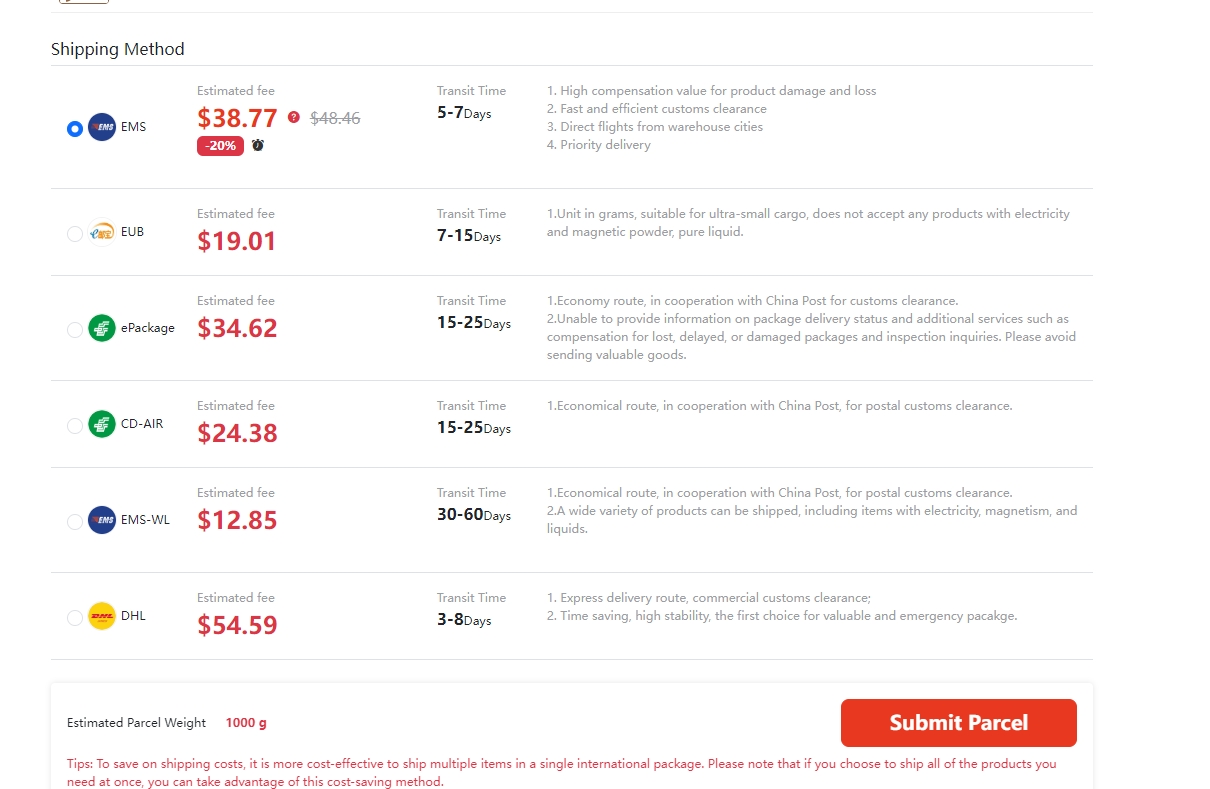
CNFans offers a variety of shipping lines, each with a different balance of cost, speed, and reliability. Express couriers like DHL or FedEx are typically the fastest and most expensive, offering detailed tracking but often having strict volumetric weight policies. Economy lines, such as EMS or SAL, present a more budget-friendly option but with longer transit times and sometimes less frequent tracking updates. Your choice directly impacts both the price and the waiting period for your haul.
How to Use the CNFans Shipping Estimator Accurately
The CNFans shipping estimation tool is your primary resource for forecasting costs. Using it effectively is key to avoiding budget surprises. While it cannot predict the final price with 100% certainty before packing, it provides a crucial baseline.
To get the most accurate result possible, follow these steps:
- Gather Item Weights: Sum up the individual weights of all items you plan to ship from your CNFans warehouse page. Add an extra 500g to 1000g (1kg) to this total to account for the weight of the shipping box and packing materials. For a more conservative estimate, add 15-20% of the total item weight.
- Input Your Data: Navigate to the shipping calculator on the CNFans platform. Enter your destination country and the total estimated weight you calculated in the previous step.
- Analyze the Results: The tool will display a list of available shipping lines with their corresponding estimated costs for that weight. Pay close attention to any notes regarding volumetric weight calculations, as some lines are more sensitive to it than others.
- Consider Item Type: If your haul consists mainly of bulky items like coats or shoes (with boxes), your parcel is more likely to be charged based on volumetric weight. If it’s mostly dense items like books or t-shirts, the actual weight will likely be the determining factor. Adjust your expectations accordingly.
Deciphering Actual Weight vs. Volumetric Weight: A Practical Comparison
To truly understand the financial impact of volumetric weight, a direct comparison is invaluable. The shipping company will always charge you for the higher of the two values. This table illustrates how two parcels of the same actual weight can have vastly different chargeable weights and, therefore, different costs.
(Note: Assumes a volumetric divisor of 6000)
| Parcel Contents | Dimensions (cm) | Actual Weight | Volumetric Weight Calculation | Chargeable Weight |
|---|---|---|---|---|
| Parcel A: 5 Hoodies | 40 x 30 x 30 | 3.5 kg | (40 * 30 * 30) / 6000 = 6.0 kg | 6.0 kg |
| Parcel B: 15 T-Shirts | 40 x 30 x 15 | 3.5 kg | (40 * 30 * 15) / 6000 = 3.0 kg | 3.5 kg |
As shown, even though both parcels weigh the same, Parcel A will be billed as if it weighs 6.0 kg due to its bulk. This is a common scenario for clothing hauls and demonstrates why managing parcel dimensions is just as important as managing its weight.
Why is My Estimated Cost Different from the Final Price?
It is a common experience for the final shipping payment to differ from the initial estimate. This discrepancy arises from several factors that can only be determined once the parcel is fully packed and ready for dispatch. Understanding these reasons helps set realistic expectations.
The primary reason is the addition of packaging. The cardboard box, moisture-proof wrapping, corner protectors, and tape all have weight. For a large parcel, this can easily add over a kilogram to the total actual weight. Secondly, the final packed dimensions determine the true volumetric weight. The way items are arranged inside the box can significantly alter its length, width, and height, directly impacting the dimensional calculation. A loosely packed box will have a much higher volumetric weight than one that is densely and efficiently packed.
A Strategic Breakdown of Popular CNFans Shipping Lines
Choosing the right shipping line is a strategic decision that balances speed, cost, and risk. Each option serves a different need, and the "best" one depends entirely on your personal priorities for a specific haul.
| Shipping Line Category | Examples | Primary Advantage | Considerations |
|---|---|---|---|
| Express Couriers | DHL, FedEx, UPS | Speed & Reliability (5-10 days) | Highest cost, very strict on volumetric weight, can have stricter customs checks. |
| Express Mail Service (EMS) | GD-EMS, KR-EMS, HZ-EMS | Balanced Speed & Cost (10-20 days) | Generally reliable with good tracking. Costlier than economy lines but faster. |
| Economy Lines | SAL, EUB | Lowest Cost | Slowest transit times (can be 30-90+ days), tracking updates may be infrequent. Best for non-urgent hauls where budget is the top priority. |
| Tax-Free / IOSS Lines | Various (Region-specific) | Simplified Customs (Taxes prepaid) | Often have strict weight and size limits. Excellent for avoiding unexpected customs fees in eligible regions (like the EU). |
Proactive Strategies to Reduce Your Final Shipping Bill
While shipping costs are unavoidable, they are not entirely out of your control. By making smart requests and decisions before your parcel is shipped, you can significantly lower the final chargeable weight and save a considerable amount of money.
The Power of Rehearsal Shipping
Rehearsal shipping is a value-added service where you pay a small fee for the CNFans warehouse team to pre-pack your selected items. They will then provide you with the exact final weight and dimensions of the parcel. This removes all guesswork. With this precise information, you can use the shipping calculator to see the *actual* cost for each shipping line, allowing you to make a fully informed decision and pay the exact amount required, with no need for refunds or top-ups.
Smart Packaging Choices: Vacuum Sealing and Removing Boxes
For hauls containing clothing, bedding, or other soft goods, requesting vacuum sealing is a game-changer. This process compresses the items, drastically reducing their volume and thus lowering the parcel's dimensions. This directly combats high volumetric weight charges. Similarly, if you are shipping shoes or other items that come in bulky retail boxes, ask for the boxes to be removed. The shoebox itself adds both weight and, more importantly, a significant amount of volume. You can ask for the shoes to be packed flat or with protective wrapping instead.
Consolidating Your Items into a Single Parcel
Shipping one large parcel is almost always more cost-effective than shipping multiple small ones. This is because every parcel has a base fee for the first 500g or 1kg, with subsequent weight being cheaper. By consolidating all your items from the warehouse into a single shipment, you only pay that initial base fee once. This economy of scale is one of the biggest advantages of using an agent like CNFans.
The Role of Declaration and Insurance in Your Total Cost
While not direct shipping fees, customs declaration and shipping insurance are integral parts of your total checkout cost. A declaration is the value you assign to your parcel's contents, which is used by your country's customs officials to assess potential import taxes or duties. Declaring an appropriate value is crucial for a smooth customs process. While under-declaring may seem tempting, it carries the risk of seizure or fines. It is wise to research reasonable declaration amounts for your specific country.
Insurance provides financial protection in case your parcel is lost or damaged in transit. The cost is typically a small percentage of the total declared value plus the shipping fee. For high-value hauls, purchasing insurance offers peace of mind and is a highly recommended practice to safeguard your investment.
How Can You Simplify Shipping Estimation from the Start?
While CNFans' tools are effective once items are in the warehouse, planning your haul *before* you even buy is the key to mastering your budget. This is precisely where the CNFan-Spreadsheet tool excels. By allowing you to log each item's anticipated weight and dimensions directly from the product page, our spreadsheet provides a dynamic, running estimate of your total haul's potential shipping cost.
This proactive approach empowers you to make informed purchasing decisions. You can see how adding that bulky jacket or extra pair of shoes will impact your estimated volumetric weight in real-time. Our tool helps you forecast costs with greater accuracy long before you commit to shipping, transforming a complex calculation into a simple, manageable part of your shopping process.
Frequently Asked Questions About CNFans Shipping Calculations
What is the most accurate way to estimate shipping costs?
The most accurate method is to use rehearsal shipping. This service gives you the final, exact weight and dimensions of your packed parcel, removing all estimation and allowing you to see the precise cost on each shipping line.
How much weight does packaging typically add?
You can generally expect packaging to add between 500g and 1500g (1.5kg), depending on the size of your parcel and the amount of protective material used. For a safer estimate, adding 15% to your items' total weight is a good rule of thumb.
Will I get a refund if I overpay for shipping?
Yes. After your parcel is officially weighed and dispatched, any difference between the amount you paid based on the estimate and the actual cost will be automatically refunded to your CNFans account balance.
Can I save money by splitting a large haul into two smaller ones?
Rarely. Due to the base fee charged for the first kilogram of any shipment, it is almost always cheaper to ship one large, consolidated parcel than two smaller ones. The only exception might be to stay under the weight limit of a specific, cheaper shipping line.